“Is my watch antimagnetic?” is a fair question, because the word on a dial promises less than most owners think. A watch marked antimagnetic usually meets ISO 764, a standard written long before phones, tablets and magnetic clasps were everywhere. Here is what the ratings actually mean, how your watch compares, and how to tell in two minutes whether it has been magnetised.
This post contains affiliate links. We may earn a small commission if you purchase through them, at no extra cost to you.
What ISO 764 Actually Requires
To be sold as antimagnetic under ISO 764 (and its German equivalent, DIN 8309), a watch is exposed to a magnetic field of 4,800 A/m, roughly 60 gauss. Afterwards it must still keep time within 30 seconds a day of its rate before the test. That is the whole bar, as the overview of antimagnetic watch standards sets out.
Two things follow from that. First, 60 gauss is modest. Small permanent magnets of the kind found in bag clasps, speakers and tablet covers can be considerably stronger right at their surface. Second, the standard allows a 30 second daily shift, so a watch can pass ISO 764 and still come out noticeably less accurate than it went in.
How Far Beyond ISO 764 Some Watches Go
| Rating | Field strength | How it is achieved |
|---|---|---|
| ISO 764 “antimagnetic” | 4,800 A/m (about 60 gauss) | Non-magnetic balance and hairspring alloys |
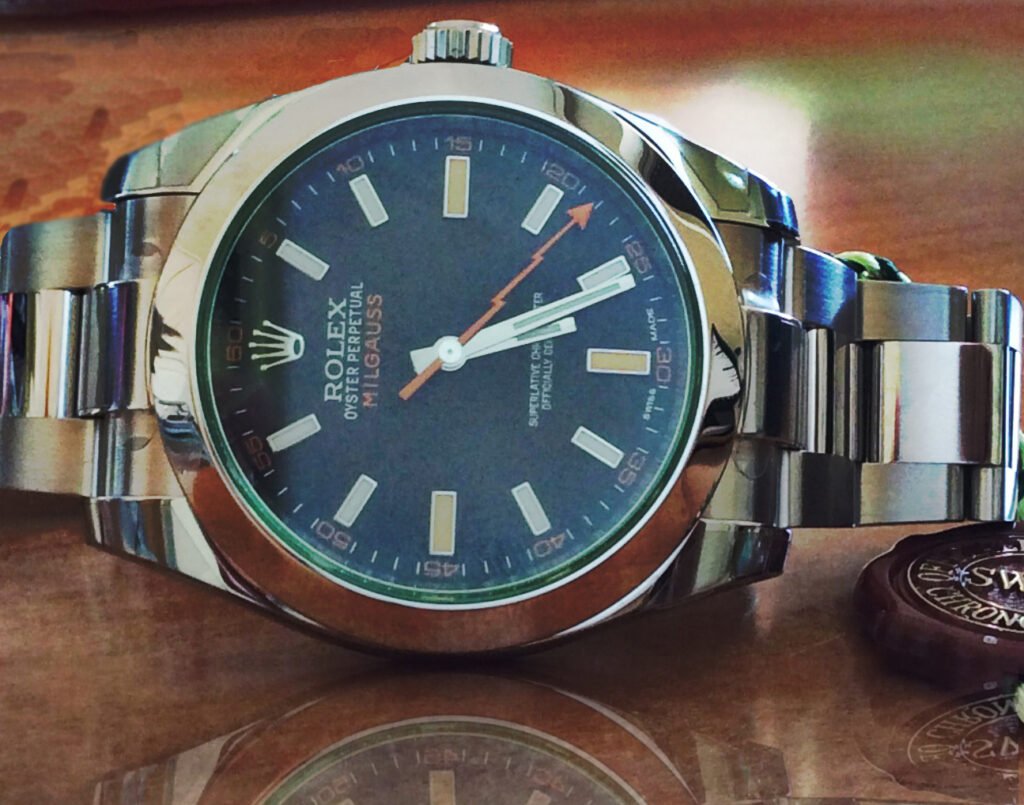
| Rolex Milgauss, Sinn mission timers | 80,000 A/m (1,000 gauss) | A soft-iron inner case that shields the movement |
| METAS Master Chronometer (Omega and others) | 1.5 tesla (15,000 gauss) | Non-ferrous movement parts, so there is nothing to magnetise |
The METAS standard goes further than resisting the field: the watch must also keep a daily rate between 0 and plus 5 seconds after the test. That is why Omega’s Master Chronometer models are so hard to upset with everyday magnets.
Where Everyday Magnetism Comes From
Omega’s own care advice names loudspeakers, refrigerators, certain handbag clasps and iPad cases as fields to avoid for watches without Master Chronometer movements. Add laptop lids, magnetic phone mounts, induction hobs and the magnetic charger stands many people keep on a bedside table. The common thread is close contact: a field weakens sharply with distance, so a watch resting on the magnet is at far greater risk than one across the room.
How to Tell If Your Watch Is Magnetised
The classic symptom is a mechanical watch that suddenly runs fast, often by minutes a day, after keeping good time. Magnetised coils of the hairspring stick together, which shortens it and speeds the watch up. The Seiko running fast guide covers this pattern in detail.
- Lay a small magnetic compass flat on a table, away from metal and electronics.
- Bring the watch slowly towards it, then move it around the compass.
- If the needle swings to follow the watch, the movement is magnetised.
Many compass apps on phones can do a rough version of the same test using the phone’s magnetometer, though a cheap physical compass is more reliable.

Fixing It
Magnetism does not damage the movement, and it is the cheapest fault a mechanical watch can have. A watchmaker can demagnetise it in a minute, often for free. You can also do it yourself with a handheld watch demagnetizer: switch it on, pass the watch slowly over it, and draw the watch away steadily before switching off. Repeat the compass test afterwards.
Quartz watches behave differently. A strong field can stop or slow the stepping motor while the watch is near it, but it usually recovers once moved away, because there is no hairspring to magnetise.
Conclusion
“Antimagnetic” on a dial usually means ISO 764: about 60 gauss and a 30 second daily tolerance. That is real protection, but modest. If your mechanical watch suddenly gains time, do the compass test before anything else. A positive result is a one-minute fix, not a service.
Related Guides
- Why is my Seiko automatic losing time?: magnetism is one of the seven causes, and the quickest to rule out.
- Why is my Rolex running fast?: the same fault on a Rolex, and Rolex’s own tolerance.
- How to store multiple watches: keeping a watch box away from speakers and chargers.
Image credits: Rolex Milgauss photograph via Wikimedia Commons, used under its licence; compass photograph by ArtHouse Studio via Pexels.