There is a specific kind of frustration that comes with waking up, reaching for your favorite automatic watch, and realizing it stopped ticking at 3:00 AM. For many new owners of mechanical timepieces, this feels like a betrayal. If the watch is “self-winding,” why can’t it even make it through a single night of rest?
Many assume the movement is defective or that the internal mainspring is broken. In reality, this is rarely a mechanical failure. It is usually a misunderstanding of how the power reserve works, and how the sedentary nature of modern life affects a movement’s winding efficiency.

The Anatomy of a Power Reserve
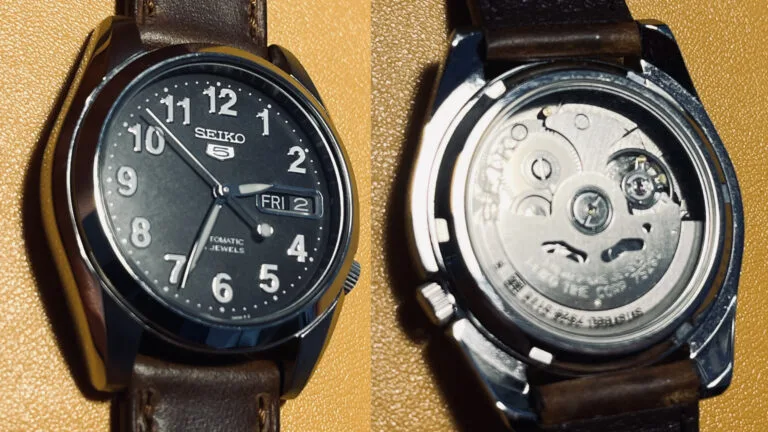
Inside a mechanical watch there is no battery and no circuit board. All the energy required to move the hands is stored in a mainspring, a long, tightly coiled strip of hardened steel or alloy housed within a circular drum called the barrel. As you move your arm throughout the day, a weighted semi-circular rotor spins freely, winding this spring tighter.
The power reserve is simply how long the watch keeps running once it is fully wound and set down.
How Much Reserve Should You Actually Have?
- Standard modern movements (ETA 2824, Seiko 4R36): roughly 38 to 42 hours
- Higher-end modern calibres: 70 to 80 hours
If your watch is fully wound when you take it off at 8:00 PM, it should theoretically run until at least the following afternoon. If it stops before sunrise, the issue isn’t the capacity of the spring. It’s that the spring never reached full tension during the day.
The “Desktop Lifestyle” and the Myth of Perpetual Motion
The primary culprit behind a failing power reserve is the modern desktop lifestyle. Automatic watches were perfected in an era when people were significantly more active. Walking to work, manual labour, and even expressive hand gestures all contribute to the rotor’s spinning.
Why Micro-Movement Isn’t Enough
Today, many owners spend eight to ten hours a day with their wrist resting on a laptop or desk. In that position the rotor stays stationary or moves only a few degrees, and that micro-movement often isn’t enough to overcome the friction of the winding gears. If the rotor only completes a few dozen full rotations, it might be putting just five or six hours of energy into the mainspring. By the time you go to bed, the watch is already on its last few minutes of stored power.
The Morning Wind Habit
Fix: Manually wind the crown 20 to 30 times each morning. This primes the spring to full tension, so the rotor only has to maintain that level through a sedentary day rather than build it from nothing. For more on safe winding, see our guide on how many hand-winding turns are safe.
Testing the Health of Your Mainspring at Home
If you suspect a genuine mechanical defect, such as a slipping mainspring bridle or a fouled gear train, a Static Reserve Test is the only way to isolate the watch’s performance from your own physical activity.
How to Run the Test
- Wind the watch fully by hand. For most watches this is around 40 to 50 full rotations of the crown.
- Set the time to exactly 12:00.
- Place the watch on a flat surface.
- Do not touch it again until it stops.
- Note how many hours it ran.
How to Read the Result
- Ran the full rated duration (for example 40 hours): the movement is healthy, and the overnight stopping is purely down to low daily activity.
- Stopped after only 10 to 15 hours despite a full wind: that points to an internal problem, such as isochronism issues or a mainspring that has lost its elasticity and needs professional replacement.
The Impact of Age, Friction, and Thickening Oils
Mechanical watches are living machines that require lubrication. Inside the movement, tiny jewelled bearings are treated with microscopic drops of specialised synthetic oil to reduce friction. Over roughly five to seven years, that oil begins to change chemically: it can evaporate, migrate away from the jewels, or thicken into a sticky paste.
When the oil thickens, drag on the gear train increases sharply. The mainspring provides a finite amount of torque, and it now has to push the gears through that sludge, so energy is burned far faster than intended and the power reserve shortens noticeably.
Fix: If your watch is several years old and you’ve noticed a gradual decline in how long it runs off the wrist, that is a clear signal it needs a Clean, Oil, and Adjust (COA) service. Our guide on signs your movement needs a full service covers the other symptoms worth watching for.
Environmental Factors That Drain Your Reserve
Magnetization
Magnetism is a silent killer of power reserves. If the coils of the hairspring become magnetised they can cling to one another, increasing friction at the heart of the watch and demanding more energy to keep the balance wheel swinging. Everyday sources include laptop speakers, magnetic laptop and tablet covers, and bag clasps.
Extreme Cold
Low temperatures make the lubricants more viscous, which increases mechanical resistance throughout the movement. If you’re training outdoors in sub-zero conditions, expect a shorter reserve than usual.
Conclusion
An automatic watch stopping overnight is rarely the death of the timepiece. It’s usually a symptom of a sedentary day, or a cry for a long-overdue service. Start with the morning manual wind, since it costs nothing and resolves the majority of cases. If the watch passes a static reserve test, you can rest easy knowing it’s a healthy machine that simply needs a little more exercise to stay awake through the night. If yours is making unfamiliar sounds as well, see our guide on whether rotor noise is normal.
Related Guides
- Why is my Seiko automatic watch losing time?: the seven causes of accuracy drift, of which an under-filled power reserve is the most common.
- Why is my Seiko 5 second hand skipping?: what an uneven seconds hand means as the reserve runs down.